
Zusammenfassung
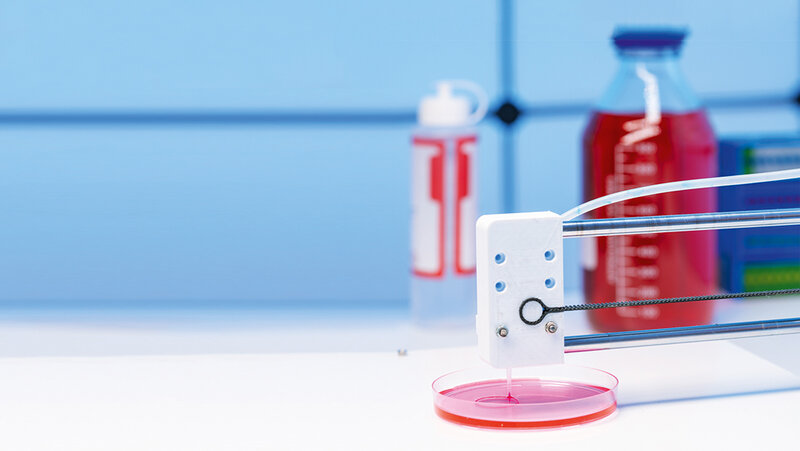
Das 3D-Bioprinting bietet ein großes Potenzial für die regenerative Medizin, Wirkstofftests und die Entwicklung komplexer Gewebemodelle. Es gilt als zentrale Technologie im Tissue Engineering, bei dem Zellen und Biomaterialien computergestützt schichtweise zu funktionellen Gewebestrukturen aufgebaut werden. Der Prozess umfasst 3 Schritte: digitale Modellierung, Druck mit Biotinten und Reifung im Bioreaktor. Es gibt zudem 3 Hauptverfahren: das extrusionsbasierte Bioprinting für große, komplexe Strukturen, das tröpfchenbasierte Verfahren für hochauflösende, kostengünstige Anwendungen und das lasergestützte Bioprinting für höchste Präzision bei empfindlichen Zellen. Die Wahl des Verfahrens hängt von Zelltyp, Struktur und Material ab. Herausforderungen bestehen vor allem in der Auswahl geeigneter Zellen und Gerüstmaterialien, die biokompatibel, stabil und abbaubar sein müssen. Die neue VDI-Richtlinie 5708, herausgegeben vom Verein Deutscher Ingenieure (VDI), schafft erstmals Standards für Begriffe, Materialien und Prozesse im Bioprinting.
Schlüsselwörter: 3D-Bioprinting, Tissue Engineering, 3D-Biodruck, Gewebe- und Organmodelle, Bioprinting-Technologien, Materialien für den 3D-Biodruck, Biotinten
Abstract
3D bioprinting offers great potential for regenerative medicine, drug testing, and the development of complex tissue models. It is a key technology in tissue engineering. In this process, cells and biomaterials are printed layer by layer using computer control to create living tissue. The process has three main steps: making a digital model, printing with bioinks, and growing the printed tissue in a bioreactor. There are three main processes: extrusion-based bioprinting for large, complex structures, droplet-based printing for high-resolution, low-cost applications, and laser-assisted bioprinting for the highest precision on sensitive cells. The choice of method depends on the cell type, structure, and material. The main challenges are the selection of suitable cells and scaffold materials, which must be biocompatible, stable and degradable. For the first time, VDI Guideline 5708, developed by the Association of German Engineers (VDI), defines standardized terminology, materials, and processes in the field of bioprinting.
Keywords: 3D bioprinting, tissue engineering, 3D bioprinting, tissue and organ models, bioprinting technologies, materials for 3D bioprinting, bioinks
DOI: 10.53180/MTIMDIALOG.2025.0664
Entnommen aus MT im Dialog 10/2025
Dann nutzen Sie jetzt unser Probe-Abonnement mit 3 Ausgaben zum Kennenlernpreis von € 19,90.
Jetzt Abonnent werden