Ionisationstechniken in der Massenspektrometrie
Zusammenfassung
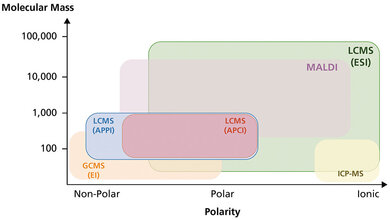
Der gesamte Artikel beschreibt die Ionisationsmethoden in der GC-MS (EI, CI) und insbesondere die wesentlich komplexeren Techniken zur Ionenbildung in der LC-MS (ESI, APCI, APPI). In der GC-MS mit EI entstehen unabhängig vom Hersteller vergleichbare und informationsreiche Spektren, die praktisch immer zum Vergleich mit einer Spektren-Bibliothek geeignet sind. So werden Identifizierungen per Bibliothekssuche möglich, ohne dass Reinsubstanzen zum Vergleich analysiert werden müssen. Ganz im Gegensatz dazu muss in der LC-MS die Ionisationstechnik an die Zielanalyten angepasst und die Ionenausbeute individuell optimiert werden. Diese Spektren sind wenig fragmentiert und zwischen den Herstellern kaum vergleichbar. Um die Identifizierungssicherheit zu steigern, wird in der LC meist die Tandem-Massenspektrometrie (LC-MS/MS) eingesetzt. Sie beruht zur Gewinnung von molekülspezifischen Informationen auf einer speziellen Fragmentierungstechnik zwischen den beiden Massenanalysatoren. Teil 1 widmete sich der weitverbreiteten Elektrospray-Ionisation.
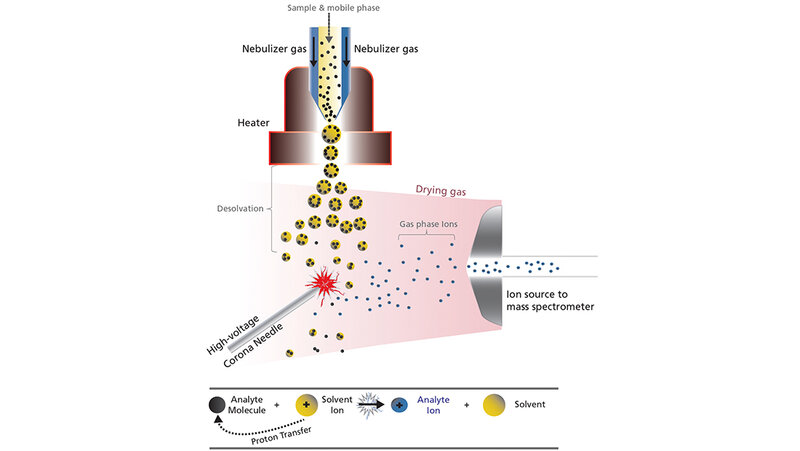
In diesem Teil werden mit Atmospheric Pressure Chemical Ionisation und Atmospheric Pressure Photo Ionisation 2 alternative API-Techniken vorgestellt, die für bestimmte Substanzgruppen bessere Ionisationsausbeuten ermöglichen als mit der ESI. Praktisch jeder Hersteller hat dafür eigene Ionenquellen beziehungsweise Quellenmodifikationen entwickelt. Es werden auch die Ionisationstechniken EI und CI der GC-MS sowie die In-Source-Fragmentierung der LC-MS erläutert. Abschließend werden sie mit den Vorzügen der Collision Induced Dissociation verglichen, wie sie nur die Tandem-MS bietet.
Schlüsselwörter: Atmospheric Pressure Chemical Ionisation, APCI, Atmospheric Pressure Photo Ionisation, APPI, Electron Impact, EI, In-Source-Fragmentierung, Collision Induced Dissociation
Abstract
The entire article describes the ionisation methods used in GC-MS (EI, CI) and, in particular, the significantly more complex techniques for ion formation in LC-MS (ESI, APCI, APPI). In GC-MS with EI, comparable and information-rich spectra are produced regardless of the manufacturer, which are practically always suitable for comparison with spectrum libraries. This enables identification via library search without the need to analyse pure substances for comparison. In contrast, in LC-MS, the ionisation technique must be adapted to the target analytes and the ion yield must be optimised individually. These spectra are less fragmented and hardly comparable between manufacturers. To increase identification reliability, tandem mass spectrometry (LC-MS/MS) is usually used in LC. It relies on a special fragmentation technique between the two mass analysers to obtain molecule-specific information. Part 1 was devoted to the widely used electrospray ionisation.
This section introduces 2 alternative API techniques, Atmospheric Pressure Chemical Ionisation and Atmospheric Pressure Photoionisation, which enable better ionisation yields for certain substance groups than ESI. Virtually every manufacturer has developed its own ion sources or source modifications for this purpose. The ionisation techniques EI and CI of GC-MS, as well as In-Source Fragmentation of LC-MS, are also explained. Finally, they are compared with the advantages of collision induced dissociation, which only tandem MS offers.
Keywords: Atmospheric Pressure Chemical Ionisation, APCI, Atmospheric Pressure Photo Ionisation, APPI, Electron Impact, EI, In-Source Fragmentation, Collision Induced Dissociation
DOI: 10.53180/MTIMDIALOG.2026.0170
Entnommen aus MT im Dialog 03/2026
Dann nutzen Sie jetzt unser Probe-Abonnement mit 3 Ausgaben zum Kennenlernpreis von € 19,90.
Jetzt Abonnent werden